
CELEBRATE SUNDAY
WITH ST. MARY'S
THE TWENTY-SIXTH SUNDAY IN ORDINARY TIME

Recognize Christ in the world.
TWENTY-SIXTH SUNDAY IN ORDINARY TIME
If we approach the parables in the Gospels as a teaching lesson for us even in the present age, we will appreciate the teachings of Christ far more. While each parable has its own historical context, Christ should have shared these stories with the understanding that history and culture changes, yet human behavior almost always stays the same. And in these parables, we find a command that is offered to us, two thousand years later, to behave exactly as God desires. In this Sunday’s Gospel, Jesus shares the parable of the rich man and Lazarus, a lesson on both using the gifts that God gives us well, and on the dignity of the human person.
READ THIS SUNDAY'S MESSAGE
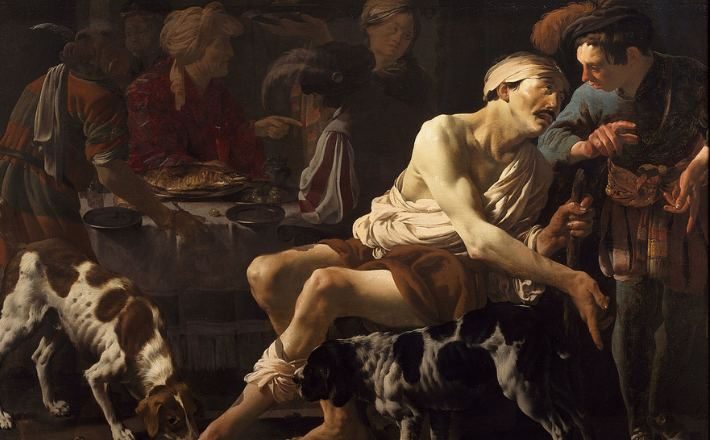
Every parable we read is a way for God to show us how things are on earth and in Heaven. Our tendency, though, is to often read into these parables and try to discover which character we might be. Instead, when reading the parables, we ought to discover who Christ might be. He is sharing these stories from his own point of view. Our behavior, on the other hand, changes from day to day; some days we might identify with the good person, while other days we may be the antagonists. But Christ never changes. This parable, which depicts a beggar and a rich man as they navigate into the afterlife, could be easily misunderstood as a mere reversal of fortunes. Clearly, this is not a teaching of Christianity, nor is it what Christ wants us to learn. If we are to recognize who he is in the parable, we can easily identify him as this poor beggar named Lazarus. Within his life, Christ was ignored, stepped over, and suffered while onlookers turned their attention away from him. Lazarus spent his days on the doorstep of the rich man, longing to merely eat the scraps from his table when those scraps were instead given to the dogs. The rich man lived in opulence, flaunted his wealth, and would have stepped over Lazarus every single day. In the afterlife, we simply see the natural consequence of their respective behavior on earth. The wording of the Gospel reveals that Lazarus was placed on the doorstep of the rich man by others, implying that he had the trust of others as a good man. Even in the afterlife, he seems to desire to help the rich man who is in a place of torment, which further indicates his character. But the rich man squandered a wealth that ultimately belonged to God; all of our material possessions in this life are gifts from God and are meant to serve Him. The rich man instead lived in comfort and in direct disobedience to the Law, and even as he suffered in the afterlife, he made demands of Abraham to have Lazarus continue to serve him.
Christ wants us to learn two things from the parable. The first is that wealth is a gift, and we must not squander that gift. But the more pertinent message for us in the modern world is alluded to in a curious little detail: this is the only parable Christ ever shares in which a character (who most likely did not even exist) is given a name. The name Lazarus means “God has helped.” Lazarus suffered from hunger and bodily wounds; in the afterlife, he is neither fed nor healed, but rather comforted. His true suffering came at the hands of being rejected by the one whom he sought, the rich man. How often do we turn a blind eye to the poor and the needy among us? How often are we desensitized to the rampant issues of homelessness and loneliness in the people in our midst? They are human beings. By giving him a name, Jesus is humanizing the poor beggar. And when we try to find Christ in the parable, we see him in the beggar who is overlooked and ignored. The poor and needy among us do not just need a warm meal, a few dollars, or a hospital visit. They do not want or need to be treated as helpless victims. Rather, they need to be comforted. They need to be treated like fellow humans worthy of dignity. In them, we ought to recognize their identity as our brothers and sisters, and by doing so, we might also recognize Christ in them. Christ is at your doorstep. With the gifts you have been given, how are you going to offer comfort to him when he is in need?
© 2026 All Rights Reserved
Site by 